Knowledge Work
Knowledge workers are found at the heart of every service- and customer-focused operation in your company - complex, event-driven activity from customer claims management and contract management to new accounts, purchase-to-pay and fraud investigations, among others.
Knowledge work is mostly UNSTRUCTURED and UNPREDICTIBLE
Cross Industry |
Healthcare |
Insurance |
Financials |
Public Sector |
|
|
|
|
|
Today's knowledge workers must perform skilled assessments using available information and communicate interactively with customers to make decisions and resolve issues effectively. Decision-making requires transparency and real-time access to content and data in the context of the business process.
Typical knowledge work includes strategic planning, customer service (insurance claims, social security), legal, investigative and analytic work, and patient care, as well as many technical projects.
Knowledge work does not have a predefined flow, so it requires clear goals, authority assigned to a performer, and definition of the means to achieve the goal.
Spectrum of work processes:
straight-through processes |
agile production processes |
human & dynamic processes |
ad-hoc & case management |
social networking, |
At one extreme, straight-through processes focused only on outcome (production) allow a high degree of automation and only little knowledge worker involvement. At the other, a dual focus on outcome and opportunity limits automation and requires knowledge workers to become strongly involved and interactive.
Adaptive Case Management (ACM) allows the business to selectively and securely empower all the people that take action and those for whom action is taken. ACM is about communication and process as ONE.
ACM leaves the automation of the low-value, highly repetitive tasks to BPM, while providing the platform for the high-value, unique and skill- or knowledge-intensive customer service processes. This is where customer loyalty is being created and maintained.
The Forrester Research report, "Harness The Power of Workforce Personas," identifies four general types of workers:
- Mobile Professionals (28%) in management, marketing or sales who use knowledge tools
- Desk-bound Contributors (24%), often in finance or HR, who use collaboration tools
- Offline Practitioners (13%) who feel that work IT lacks compared to home PCs
- Accidental Workers (35%) who use computers because they have to
Empowering Knowledge Workers
Businesses benefit from empowering employees and turning as many production workers as possible into knowledge workers. Giving these knowledge workers the power to create exactly what they need to achieve the best possible process outcome for the customer is critical for success and growth.
Consolidating ECM, CRM and BPM with enterprise architecture, Adaptive Case Management ACM provides the knowledge worker with a single, consolidated view of the customer.
Adaptive Case Management for Knowledge Work (click image to zoom) |
Papyrus Customer Experience (click image to zoom) |
Papyrus Adaptive Case Management:
Advantages for the Knowledge Worker
To fully empower knowledge workers, Papyrus provides advanced case management technology that offers a comprehensive, high-value package of business benefits and user features.
Combining content, data and process to ensure business and communications flexibility for knowledge workers, Adaptive Case Management enables on-the-fly learning and exceptions alongside role-based content control and collaboration.
Unique Benefits of Papyrus ACM:
- Empowers non-technical business users
- Builds virtual process organizations
- Users create dynamic knowledge processes
- Assembles optimized process templates
- Delivers real-time customer perceptions
- Gathers actionable process knowledge
- Links business and process goals
- Provides operational transparency
Unique Features of Papyrus ACM:
- Consolidates 5 elements: Data, Activities, Content, Goals/Rules, GUI
- Adapts the process in real time – Design-by-Doing
- Embeds all decision-relevant data
- Users define business rules at run time - Natural Language Rule Editor
- Add new actors and tasks, as needed
- Actors receive recommendations by the User Trained Agent
- Alternative decisions by actors are audited
- No restriction in execution – calling Web services, human workflow with automated workflow, task execution/letter writing, job management, etc.
- Inbound content classified, data extracted and validated at point of entry
- Embedded security on the object and function levels
Adaptive Cases
Empowerment is not about social networking, it is about authority, goals and means. Effectiveness and transparency are achieved by linking customers and process performers in the process context.
"Case management departs from the traditional view of structured and sequential predefined processes. Instead, workflows are nondeterministic, meaning they have one or more points where different continuations are possible. They are driven more by human decision-making and content status than other factors." - Gartner Group
Case Management does not tightly control the case from initiation to its final resolution. Arbitrary document content, collaborative decision-making and customer interactions are important elements of case management. With this in mind, case management collaboration can be improved with a more user-friendly infrastructure and more adaptability, rather than more flexibility. Case functionality should improve over time from business user input rather than through programmed add-on functions or work-arounds. Further, knowledge workers can share and learn from each others' experience for substantial business benefits.
Papyrus Consolidation of Data, Content, Rules, Goals and Interaction
Papyrus ACM is communication and process in ONE.
Papyrus consolidates the functions of process, content and customer communications management, providing SOA and other interfaces to integrate with ERP and other internal systems and support central project management and deployment for all definitions assets.
Empowering knowledge workers requires adaptive technology to enable business communications and processes using five basic elements:
Entities: SOA and other interfaces connect the silos to the process environment
Goals and goal rules: Direction and measurement ensure results
Content: Inbound and outbound correspondence
Rules: Natural language rule (NLR) editing
GUI: Same across desktop/portal - authorized users define forms and wizards from Widgets
Goal-driven Knowledge Work
Process management is not micro-managing everyday business processes from the boardroom. Empowerment is certainly not decision-making authority for everyone about everything.
Empowerment is enabled by transparency. Transparency down-the-line helps knowledge workers to understand the business goals. Transparency up-the-line enables monitoring to verify the efficiency of that activity. If the customer can participate in that up-the-line transparency, then it will be substantially easier to judge his perception of quality.
Knowledge work describes fluid business processes that cannot make use of predefined flowcharts and decision points that guide execution. For such unpredictable work, it is often more effective that larger milestone plan and goals, as well as commonly used procedures, begin as part of the initial template or as options available to participants when the evolving situation calls for it.
Goal-oriented, Adaptive Processes
BPMN 2.0 - Papyrus Business Process Management - IT View (click image to zoom) |
Papyrus Gantt charts – Adaptive Process Management Business View (click image to zoom) |
Papyrus Goal oriented processes (click image to zoom) |
The reality of BPM shows that 'Measure-to-Manage' optimization is counterproductive to improvement and innovation. Only empowered actors can use their intuition and experience for sensible action.
Papyrus recognizes the importance of goal-driven process by incorporating the use of milestones and rules to manage path and control progression, along with sub-goals – reusable sub-processes available in multiple applications and in a balanced scorecard.
- Milestones and rules manage the path and progress
- Business view of BPM enables goal-relevant decision-making
Processes in the Papyrus platform are collaborative activities performed on architecture data models and content. State/event chains of execution are used rather than rigid flowcharts.
Defining goals and process plans
(click image to zoom) |
Defining Tasks by assigning participants and placeholders (click image to zoom) |
Defining data and content (click image to zoom) |
Adaptive technology enables model-based process definition and execution. It also collects 'actionable knowledge' based on process patterns created by business users. Actionable knowledge is not merely data, information or descriptive text but also knowing which action will lead from the current situation A to a desired situation B.
With this approach, knowledge workers are enabled by adaptive technology to implement many small, low-cost improvements that follow the business architecture and can be verified for benefits within days.
Design-by-Doing
"Adaptive processes only really become processes
when the components are assembled at run time by the user."
– Keith D. Swenson
The team owning the process must be in charge of additions, improvements, and corrections and, therefore, a new adaptive technology is required.
"End users do not just influence the design,
they actually create the process on the fly."
- Max J. Pucher
The Papyrus WebRepository enables the modeling of data and content entities for business users to assemble processes from application-specific framework libraries. It is not required to create flowcharts, but users can interactively assemble the various elements into a process and iterate in their use until they become more stable and influence the basic standard template.
Goal Achievement
With a consolidated and customizable GUI for monitoring and evaluating case activity and resolution, management can continuously measure against quality parameters for process execution and business goal achievement. Real-time auditing can be performed using boundary rules or by post-verification of archived process tasks.
Agility is not a product feature and it cannot be enforced by methodology. It can only be achieved through the agile mindset of management and employees who will put the right technology in place that empowers people. Process maturity is not about how well processes control employees, but how much process control is given to employees to achieve goals and outcomes.
Papyrus enables the executive to define the goals and outcomes for each process owner. High-level BPMN flowcharts can be used for end-to-end process dependencies instead of step-by-step activities.
Adaptive process technology addresses the needs of business users who perform emergent or unstructured knowledge work - in contrast to repeatable production work. This requires a kind of technological empowerment rather than a new management methodology.
Papyrus Natural Language Rules
Business rules are necessary to ensure that decision-making, action and communication in knowledge work delivers on priorities like accuracy, relevancy, progress and regulatory compliance – and aligns with corporate and departmental policies and goals.
Because they are essential to meeting internal and external standards of performance in case management, business rules must be universally accessible and consistent while also being readily available in the change management cycle - which is often accelerated in knowledge work. Especially in ACM, business users must be able to define and refine activities independent of but linked to back-end application systems.
The Papyrus Platform does not restrict business users in execution but instead guides them by means of case definitions, monitored by business rules and measured by goal fulfillment.
Rule entry in Papyrus is a natural language (NL) capability without complex syntax that guides the user and offers both multilingual presentation and editing from a single-rule definition.
Papyrus Natural Language Rules (NLR) Editor (click image to zoom) |
Defining rules (NLR) (click image to zoom) |
NL rules have to be usable in the GUI as normal business user entry for queries also. That means that must be multi-lingual in presentation and editing from a single-rule definition. NL rules must be able to access any data model stored in the central metadata repository.
When a business user fires a rule he just has created, the execution of that rule has to be verified against and secured with the user role/policy setting. When the rules are executed in a different engine the security aspects become very difficult to manage.
Key Values of Papyrus ACM
for the Executive & Knowledge Worker
- Analyze processes via 'Design by Doing' to create processes on the fly
No restriction in execution – calling web services, human workflow with automated workflow, task execution/letter writing, job management etc. - Variants or exceptions not required – adapt the process at any moment with goal and sub-goal support
- Embeds all decision-relevant data
- Authorized use and change of real data
- User definition of business rules at run time using the Natural Language Rule Editor
- Add new actors and tasks, as needed
- Actors receive recommendations by the User Trained Agent
- Auditing of alternative decisions by actors
- Goal-driven structure
To empower knowledge workers Papyrus provides:
- Master data models mapped to back-end interfaces
- Management-defined goals and outcomes
- Process adaptability by business users
- Embedded business rules mapped to master data and processes
- Inbound content to be classified, data extracted and validate
- Outbound business content maintained by business users
- User presentation is definable by users per user role
- Embedded security on the object and function levels
ACM Empowered: The Business Communication Loop
Processing a case involves a substantial amount of business communication - both incoming and outgoing – which adds to the complexity of effectively managing successful progress and resolution.
A mid-size or large company may handle thousands of letters, e-mails and phone calls a day, with hundreds or thousands of workers producing documents for each, to store, access and even update on individual desktops or file servers.
Obviously, capturing and archiving inbound documents is an essential element of a full case management solution. Huge amounts of documents of all types may reach the business from consumers or partners. Typically, these contain known forms, semi-structured accounting documents and totally unstructured letters.
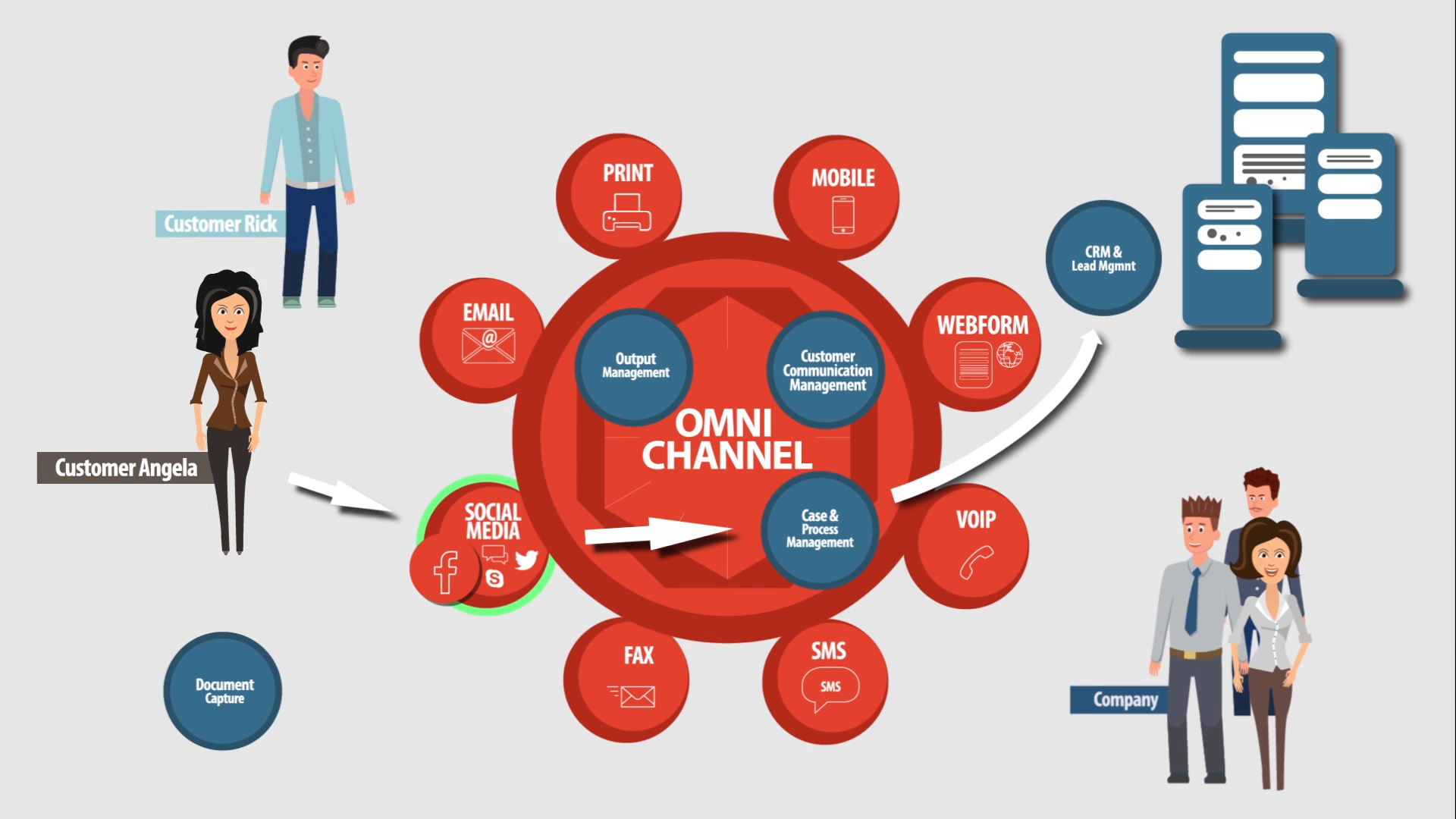
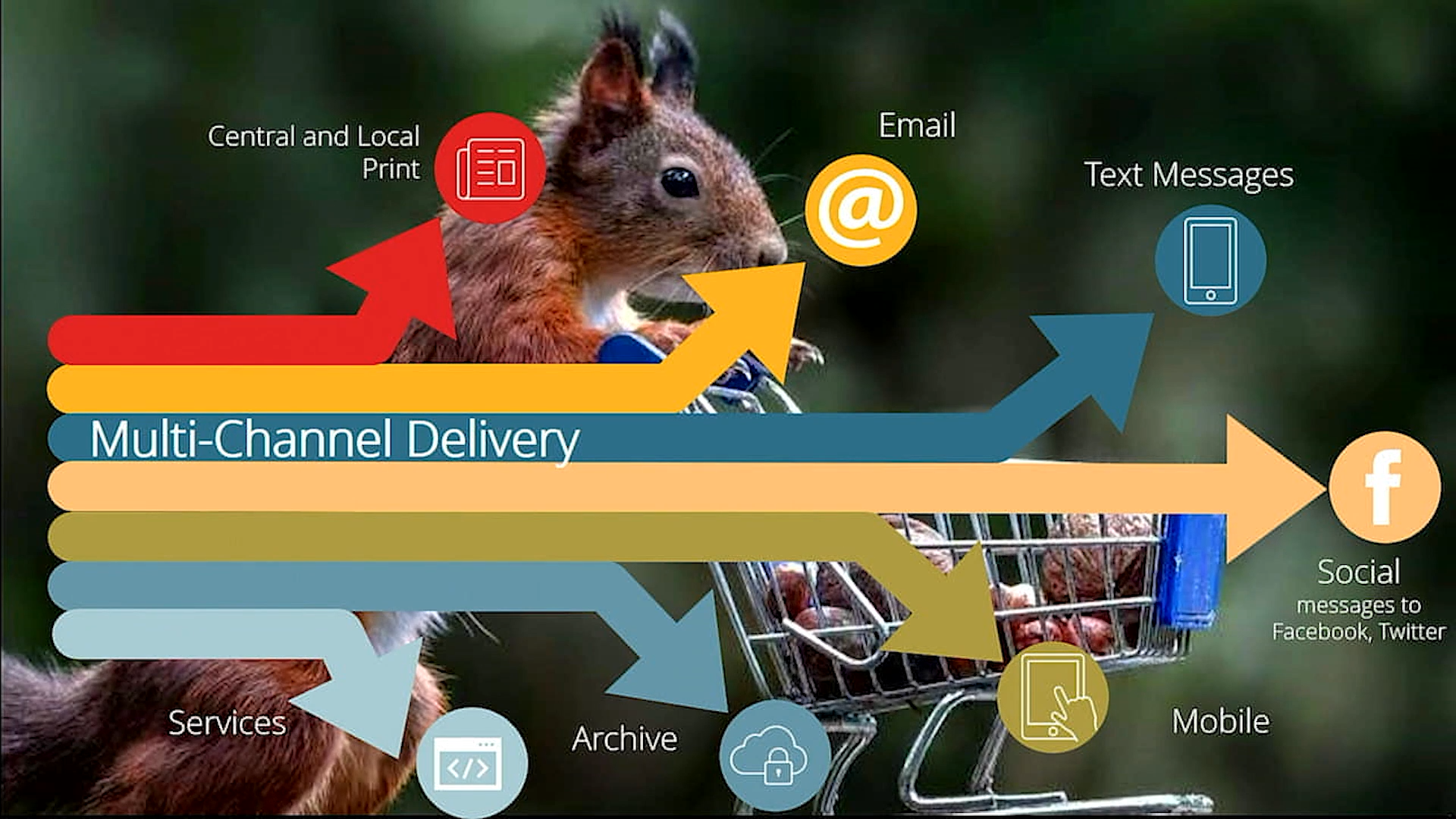
Most process management products are content-blind and most content products have limited or no process capability. While Papyrus uniquely consolidates both, it also provides consolidated content delivery through all outbound channels: print/mail, fax, e-mail, Web and mobile.
Informal Communications Network
Bringing together experience and unique skills to perform key information and communication roles in your business, knowledge workers require powerful but flexible and easy-to-use business applications to manage and improve the myriad and overlapping processes required for full-circle customer communications and case management.
These processes include integrated business correspondence, multichannel delivery and archiving, as well as cross-system and inter-departmental processes.
RULE #1: "There is no process without content,
and content without process you don't need."
Communication influences processes
(click image to zoom) |
Informal communication network (click image to zoom) |
Embed inbound business communication
Papyrus is tightly integrated with enterprise content management (ECM) to achieve the goal of a fully adaptive environment. Content - scanned and digitized as well as business documents created from business data - always must have a solid context to the case.
A primary challenge is the automated capture processing of these documents, as they are received, in an efficient way that will quickly start activities triggered by the content of these documents. One way to start the proper processing of inbound documents is the use of classification taxonomy. Documents are handled based on the way they look alike before any OCR reading has taken place. That can be combined with barcode reading to identify relevant detail information such as case or customer numbers.
Many document management products offer lifecycle functionality. For Papyrus this is integrated transparently for the business user as he generates content interactively, using defined processes for the creation, review, and signoff of customer- or partner-bound documents. In contrast, pure content products do not provide mapping of variable business data into the document components that make up the business documents.
Papyrus captures ALL incoming content, performs machine-learning classification, extracts and validates business data, and executes automated business responses as well as initiating straight-through or user-interactive processes. Papyrus provides Natural Language Rule (NLR) definition for business users that can be executed in the process environment directly and reused as templates in any process.
Embed outbound business communications
Businesses need to support and possibly enhance communications to their customers, clients, stakeholders, agents and vendors. These documents can be any kind of letter, statement, request for information, rulings, contracts, claims payments or denials, status reports, account notices, serial letters, welcome letters/kits, new offers and even litigation paperwork.
Data-driven, specific business documents must be generalized or personalized. While the core structure is defined once by IT experts, including the possibility to freely map business data, the final content must be under full control of the business users. Essential enablement of business users must include maintaining text/messages including multi-language, resource management (fonts, forms, logos), change management supporting batch, online, interactive (thin and thick Client) and Web form/document solutions.
Papyrus outbound workflow (click image to zoom) |
||
Papyrus batch, online, user interactive documents (click image to zoom) |
Papyrus Template Manager (click image to zoom) |
Papyrus Content Manager (click image to zoom) |
Embed social media and Google Maps
Papyrus enables rich Internet apps, chat, wikis, blogging, user-configurable GUI presentation and social interaction with co-workers, all under the control of role/policy authorization and in context with the process.
Access to relevant data and content
(click image to zoom) |
Embed social networks (click image to zoom) |
Embed Google maps (click image to zoom) |
Papyrus EYE Widgets
Papyrus enables intuitive, fully functional graphical user interfaces. Empowered employees can create user interfaces powerful without programming effort through the powerful Papyrus EYE Widget technology. Widget definitions are centrally managed, version-controlled and time-stamp deployed to all production servers. EYE Widget applications are deployed identically in the desktop and in the browser.
Authorized knowledge workers can build their own GUI by using existing Widgets from the Repository and populating those with business data.
Papyrus Adaptive Process Platform
The Papyrus Platform offers a comprehensive, flexible and scalable solution for ACM Adaptive Case Management Applications. Organizations can define, measure and manage process, content and data in complex service environments with a shared customer view and customized GUIs.
The Power of One System
The mission critical ACM applications are built from a foundation of Papyrus standard software components.
Papyrus Standard Software:
Functionality and Applications
Papyrus System Components (click image to zoom) |
Papyrus Standard Software and Applications (click image to zoom) |
Papyrus ACM Quick Facts
Papyrus Adaptive Case Management offers your organization the most advanced software solution for enabling knowledge workers to manage the complexity, quality and change of case-related activity:
- "Design by Doing" - users create, modify and analyze processes on the fly
- Flexibility in execution of ACM at the manager, architect and knowledge worker levels
- Tight but flexible integration and management of process, content and data
- Consolidation of data, content, rules, goals and interaction for compliance
- Consolidated view of inbound and outbound activity, documents and status
- User presentation (GUI) is user-definable by role using Widget technology
- Outbound business content is developed and maintained by business users
- Knowledge workers leverage personalization, automation and organization of communications
- Consolidation of multichannel outbound delivery for personalized communications
- Management can define quality goals and outcomes
Frequently Asked Questions on ACM
- Is Papyrus compatible with the Microsoft .net framework environment?
Yes.
- Is Papyrus compatible with Microsoft products?
Yes.
- The product we are looking for has to be highly customizable - what kind of customization does Papyrus offer?
The Papyrus Platform uses a model-preserving concept, which means that all application, content and process functionality is freely definable as objects, relationships and rules. The supplied Adaptive Case Management framework can be modified and extended without programming by a trained person. Content, processes and rules can be modified by non-technical, properly authorized business users.
- What workflow capability does Papyrus offer?
Papyrus ACM offers standard BPMN 2.0 workflow capability. It also offers adaptive processes, which are defined through goals by business users and can be modified at runtime.
- What is the out-of-the-box reporting capability of Papyrus?
The Papyrus Platform allows you to monitor any process or data aspect, including low-level auditing of system functions. Its powerful reporting engine that can query, gather and process any data from running or completed processes and create tables or charted reporting in a user dashboard, in PDF or in print. - Does Papyrus have a digital signature capability?
Signing and encrypting PDFs is a standard feature of Papyrus. All users must be authenticated to act in the platform. There is also a biometric interface for authentication and an interface to digitally sign documents with a preferred digital signature solution. - Can documents be placed in a repository and attached to a case at anytime in the process?
Any inbound content can be captured, classified, data extracted and stored in the repository archive (Papyrus or external) and automatically assigned to a case, a user or even a particular task. Any required outbound content can be requested by users, filled with process data and then e-mailed or printed and stored in the repository archive (Papyrus or external). - What versioning capability does your product offer?
The Papyrus Platform offers full versioning for all objects and process definitions with timed, automatic deployment.

Adaptive
Case Management:
Empower Knowledge Workers
Inbound
Mail Processing

Document
Capture Solution
Enterprise
Content Management
Turning
Green into Gold -